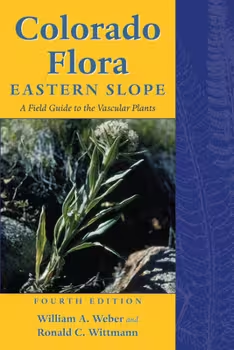
Weber and Wittmann’s “Colorado Flora: Eastern Slope” stands as a monumental, if somewhat daunting, achievement in regional botany. It is a work of meticulous scholarship, meticulously documenting the vascular plant life of the eastern slope of the Colorado Rocky Mountains. This is not a casual field guide; it is a taxonomic and distributional treatise aimed squarely at the serious botanist and dedicated naturalist.
The book’s strength lies in its comprehensive coverage. Weber and Wittmann have compiled an exhaustive inventory of the region’s flora, encompassing both native and introduced species. The taxonomic descriptions are detailed, often bordering on technical, reflecting the authors’ deep expertise and commitment to accuracy. This level of detail is invaluable for researchers and those seeking to accurately identify specimens.
The keys to species, while essential for identification, are complex and require a solid foundation in botanical terminology. This further reinforces the book’s suitability for a specialized audience. The casual wildflower enthusiast may find the keys challenging, if not impenetrable.
Distributional information is another strong point of the book. Weber and Wittmann provide detailed accounts of the geographic ranges of each species within the eastern slope region, often including specific locality data. This information is invaluable for understanding plant biogeography and for conducting ecological studies.
However, the book’s visual presentation is its most significant limitation. The absence of color photographs is a major drawback, particularly for those unfamiliar with the region’s flora. The inclusion of line drawings is helpful, but they often lack the detail and clarity that would truly enhance the identification process.
Furthermore, the book’s focus is primarily taxonomic and distributional. Ecological information is often limited, with brief mentions of habitat preferences and associated plant communities. This omission diminishes the book’s value as a tool for understanding the broader ecological context of the region’s flora.
The book’s organization, while logical, can be challenging for those unfamiliar with botanical nomenclature. The use of technical terminology and the sheer volume of information can be overwhelming at times.
Weber and Wittmann’s writing style, while authoritative, is not particularly engaging. It is clear, concise, and scientifically rigorous, but it lacks the narrative flair that can transform a taxonomic treatise into a captivating read.
In conclusion, “Colorado Flora: Eastern Slope” is a significant contribution to the botanical literature of the region. Its comprehensive coverage and detailed taxonomic information make it an invaluable resource for researchers and serious botanists. However, its technical density, limited visual presentation, and narrow focus on taxonomy and distribution make it less suitable for a general audience. While it remains a monumental achievement, it is ultimately a specialized work intended for a specialized readership.


Reviews
There are no reviews yet.