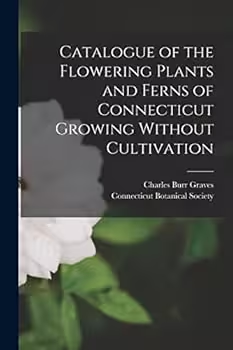
Charles Burr Graves’ “Catalogue of the Flowering Plants and Ferns of Connecticut Growing Without Cultivation” is a meticulously compiled, if somewhat dry, taxonomic record of the state’s spontaneous flora. It stands as a significant historical document, providing a snapshot of Connecticut’s botanical landscape as it was understood at the time of its publication.
Graves’ strength lies in his exhaustive attention to detail. The catalogue is a testament to his dedication to documenting the state’s plant life, encompassing both native and naturalized species. The taxonomic descriptions, while concise, are precise, reflecting a deep understanding of botanical nomenclature and classification.
The book’s organization is logical, adhering to standard taxonomic arrangements. Graves provides a systematic listing of species, with detailed information on their distribution within Connecticut. This distributional data, while valuable for historical context, may be outdated in some instances, given the changes in land use and the introduction of new species since the catalogue’s publication.
However, the book’s primary focus on taxonomy and distribution limits its appeal to a broader audience. The absence of ecological information is a notable shortcoming. Graves largely neglects the intricate relationships between plants and their environment, focusing instead on their classification and geographic occurrence. This omission diminishes the book’s value as a tool for understanding the broader ecological context of Connecticut’s flora.
Furthermore, the book’s format is decidedly academic. It lacks the engaging narrative or visual aids that would make it accessible to a general readership. The absence of photographs or illustrations is a significant drawback, particularly for those unfamiliar with the state’s plant life.
The book’s age is also a consideration. While Graves’ taxonomic work remains largely valid, some of the nomenclature and classification systems have been updated since its publication. Recent advancements in botanical research and changes in species distribution may render some of the information outdated.
Graves’ writing style, while authoritative, is not particularly engaging. It is clear, concise, and scientifically rigorous, but it lacks the narrative flair that can transform a taxonomic catalogue into a compelling read.
In conclusion, “Catalogue of the Flowering Plants and Ferns of Connecticut Growing Without Cultivation” is a valuable historical document that provides a detailed taxonomic record of the state’s spontaneous flora. Its comprehensive coverage and meticulous attention to detail make it a significant contribution to the botanical literature of Connecticut. However, its focus on taxonomy and distribution, coupled with its academic format and lack of visual aids, limits its appeal to a specialized audience. While it remains a significant resource for researchers and serious botanists, it is ultimately a specialized work intended for a specialized readership.



Reviews
There are no reviews yet.